In discussing characteristics of instructional design models, Branch (2012) explains how the instructional design (ID) process is comprised of a set of procedures for systematically developing education and training materials. He points out how most of the models of the ID process include five phases of activities: analysis, design, development, implementation, and evaluation, often referred to by the acronym ADDIE. Branch highlights how ADDIE is not a specific, fully elaborated model in its own right, but rather a colloquial term used to describe a systematic approach to instructional design.
While instructional design employs a systems approach, Branch recognizes that different learning outcomes often require various applications to a general systems concept. For example, values about priorities (in terms of outcomes such as effectiveness, efficiency, and appeal), along with conditions (factors such as needs, audience, content, etc.) inform the nature of the situation that governs one’s instructional design work, and ultimately informs a designer’s choice of instructional methods.
Honebein and Honebein (2015) found that “when choosing instructional methods, instructional designers trade-off or sacrifice an outcome, such as effectiveness, efficiency, or appeal” (p. 1). In instructional planning theory, this is what Reigeluth and Carr-Chellman (2009) label as values about priorities. Honebein and Honebein (2015) suggested that “instructional theory has its own iron triangle associated with values about priorities, where a designer’s choice of method yields good success in only two of the three learning outcomes: effectiveness, efficiency, and appeal” (p. 3).
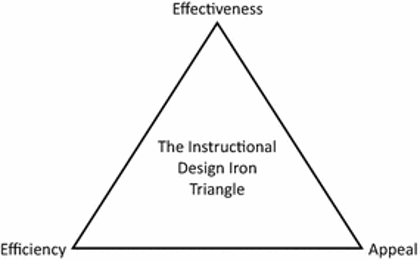
Figure 1. The Instructional Design Iron Triangle (Honebein and Honebein, 2015)
While designers arrive at an instructional design with their own set of values, Reigeluth and Carr-Chellman (2009) point out that “the values of the designer are less important than the values of the “owners” of the instruction, the teachers, the learners, and the other beneficiaries (e.g., employers and communities)” (p. 23). It can be understood, therefore, that a designer’s values will require deference to the values of the stakeholders to arrive at the most appropriate instructional theory. As a cause of values, designers hope to balance learning outcomes without any kind of sacrifice in the instruction they design.
Reflect backwards or forwards. In conducting analysis as part of the ADDIE process, how did the nature of a situation that governed your instructional design work (i.e., values about priorities) inform your instructional design process?
References:
Branch, R. M. (2012). Characteristics of instructional design models. In R. A. Reiser & J. V. Dempsey (Eds.), Trends and issues in instructional design and technology (3rd Ed.), (pp. 8-16). New York, NY: Pearson Education.
Honebein, P. C., & Honebein, C. H. (2015). Effectiveness, efficiency, and appeal: pick any two? The influence of learning domains and learning outcomes on designer judgments of useful instructional methods. Educational Technology Research and Development, (6), 937.
Reigeluth, C. M., & Carr-Chellman, A. A. (2009). Understanding instructional theory. In Reigeluth, C. M. (Ed.), Instructional-Design theories and models, Vol. III: Building a common knowledge base (pp. 3-27). New York, NY: Taylor and Francis.
 Andrew R. Claassen
Oh boy… The most significant instance of this I can think of is when I was asked to design and create a brief online “module” about best practices in and quality assurance of online course design & teaching for faculty. The request was from higher administrative stakeholders and from their perspective, all of the best practices that we promote and the quality assurance process can be boiled down to one or two hours of instruction (tops). I wholeheartedly disagreed, knowing that this was a new process for faculty, and thought making the process seem really simple could backfire and potentially cause fewer faculty to participate. However, I like my job, so I did the best I could to simplify best practices for designing online courses and the peer review process, with some help from colleagues. We had no way of determining whether faculty taking the online module were learning (since we wanted it to be quick and the concepts go far beyond simple recall). However, the module served a better purpose as a stepping stone. It helped faculty get the quick and dirty when they needed to hit the ground running, but it also led them to learn more about best practices and quality assurance.
LikeLike
I have not had the opportunity to dabble much into the design process outside of class projects, so my experience is more from the instructor point of view. At work, my curriculum is planned out for me to meet the business partner’s goals. I am fortunate to have the ability to structure the day-to-day classes to meet the needs of the learners. The design team does not always see eye-to-eye with the trainers, and if I had to follow their outline strictly, I don’t think I could be nearly as effective as a trainer. My goal is to help bridge that gap!
LikeLike